|

|
|
More
about Blepharoplasty (Upper and Lower Eyelid
Rejuvenation Surgery). Everyone knows that beautiful eyes can illuminate a persons
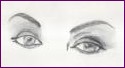
face. Eyes
make a face expressive. In today's society eyes are very
important. With our eyes we usually make the first contact
with others.
|
|
|
|
Your eyes are the windows of your
soul. Your eyes show whether you are happy, sad
or tired.
|
Unfortunately, the eyelids are the first to show
signs of ageing. When a person gets older, the eyelids loose their
elasticity. The skin around the eye loosens, the muscle relaxes and small
wrinkles appear. You are undoubtedly familiar with them: the small crow's feet.
After that dark rings under the eyes and "bags" can appear. This makes you look
tired, weary and sad. Ageing can cause deep wrinkles and bags, but -just as
important- they can also be a result of hereditary factors. This explains why
also young people can suffer from sagging eyelids and bags. The degradation of
the skin of the upper eyelids results most of the time in a surplus of skin, the
so-called excess skin. The amount of excess skin can be so important that it
obstructs a clear vision.
Place both your thumbs on your upper eyelid and carefully pull
the eyelids slightly up. Does your vision improve? Do you see better?
Do you
look better?
In
order to look a few years younger, many consult an oculoplastic
surgeon, a doctor specialised in
plastic surgery of the eyelids, to perform a blepharoplasty, an eyelid correction. A
simple and almost risk free surgical intervention, but one that requires a very
skillful surgeon.
A well
performed blepharoplasty lets you regain that youthful, fresh, healthy and so
much desired look.
Some patients try to remedy and camouflage the
problem with everything that is available at the moment on the cosmetic market.
And there certainly are good products on the markets. But the results are not
effective, not long lasting and never entirely satisfying. The result of a simple
surgical procedure is, contrary to the available cosmetic treatments, permanent
and highly satisfying.
|
|
Who can
benefit
Excess skin and bags
often have nothing to do with your age. Very often your ancestors are to blame.
Hereditary factors are a determining factor or at least play a major role. Women
usually only decide to have a surgical intervention when they are in their
forties or fifties. However, the predisposition and the contours of the eyes are
already visible and can be ascertained at a much earlier age. Therefore, an
eyelid correction does not need to be postponed until a woman reaches a certain
age. The procedure can be done much earlier, as young as the age of 18.
There is no need to wait
to undergo this surgical procedure to correct and enhance your look until you
have reached an advanced age. This applies to women as well as to
men.
You suffer from
excess skin
Excess skin (a
surplus of skin of the upper eyelids) can be caused by many factors. One is
heredity. The others are ageing and exposure to ultra violet radiation, like the
rays of the sun. The surplus skin makes the eyelid heavier and causes you to
look tired and sad. Moreover, it can impair your vision.
Of all the
available plastic surgical procedures, the eyelid correction (or
blepharoplasty)
is the one that is performed the most. With a blepharoplasty of the upper
eyelids the excess skin and the underlying fat is surgically removed,
immediately resulting in a younger and more attractive
look.
You have "bags"
under your eyes
Like excess
skin, dark rings and bags under the eyes can be caused by hereditary
factors.
Whilst time is progressing the dark rings and bags become more visible. However,
there is no need to accept that as just a fact of life. Bags can be minimised
neatly or -in most cases- be removed completely by a simple surgical
procedure. This applies to women as well as men. The correction of the lower
eyelids is done transconjunctivally. This means that it is done from the inside
of the eyelid. There are no sutures needed and there are no visible scars. The
result is a very natural, refreshed and younger look.
Eyelid corrections for
men
The most effective (and
mostly performed) aesthetic procedure for men is the correction of the lower
eyelids. Many men suffer from heavy bags underneath their eyes.
However, these
are easily removed. The correction is performed through the inside of the lower
eyelid, leaving no scars and without the need for suturing.
The
correction of the upper eyelids in men is highly effective, but Dr.
Bouzouaya is
of the opinion that it should be performed with subtlety. The intervention, that
gives a very natural and beautiful result with women, can -when performed on
men- leave a "surgical" and unnatural impression. Therefore, Dr. Bouzouaya
advises not to remove too much skin and underlying fat. With this in mind, the
result will be a younger and refreshed look.
 or see his
prices here or see his
prices here
The
mini-incision technique
Doctor Bouzouaya is constantly seeking to
improve today's techniques for blepharoplasty. He uses state of the art laser
technologies to perform his blepharoplasties.
To further reduce bruising
and swelling, to minimise complications and to limit the recovery period after
surgery to the absolute minimum, Dr Bouzouaya perfected the
transconjuctival
lower lid blepharoplasty with his own "mini incision" technique. Instead of
opening the entire lower lid from the inside to remove the underlying fat, he
only makes three mini button hole incisions which allow him to sculpt the
underlying fat from the three underlying fat pockets. These mini incisions do
not require any suture and heal very quickly. This personal technique was
published in the US medical journal "Ocular
Surgery News" and was translated in Spanish and even in Japanese. The technique
is
now performed by a growing number of doctors. In order to further optimise the
technique Dr. Bouzouaya developed an instrument, the
Chedly Thermoplasty. With this instrument Dr.
Bouzouaya can shrink
the skin from inside the button hole incisions. Thereby improving the final
result of a lower lid blepharoplasty.
Because Dr Chedly Bouzouaya
found
that the presently available medical instruments did not allow him a perfectly
accessible operating field, he designed a medical instrument that does exactly
that. The Chedly Lid
Retractor is patented in the USA, fabricated and
commercialised by Ellman Inc., New York. It helps surgeons gain better access to
the surgical field and it helps to minimise manipulation of the eyelids and
reduces the recovery period.
WHAT YOU SHOULD KNOW ABOUT
BLEPHAROPLASTY
-
Blepharoplasty (eyelid
tuck) can be performed on your upper and/or lower eyelids.
-
Eyes generally show age
before other facial structures. A Blepharoplasty will give a refreshed, alert
appearance to your eyes.
-
Blepharoplasty is
performed using local anaesthetic (numbing medication). We may give you some
oral pre-medication to relax you.
-
On the upper eyelid, a
Blepharoplasty will remove excess tissue which may include skin, muscle and
fat.
-
For an upper lid
blepharoplasty we use stitches that will need to be removed or a biological
glue. The stitches are well hidden in the lid crease of the upper eyelid. After
approximately one month nobody will be able to detect the scar.
-
A Blepharoplasty does
not correct sagging eyebrows. A brow lift is required to elevate eyebrows. This
can be performed separately. In some patients, a Blepharoplasty may actually
make the eyebrows droop more. In these patients, a browlift is required to give
the best results.
-
After an upper eyelid
Blepharoplasty, you should expect bruising and swelling. This actually normally
resolves over one week.
-
For a lower eyelid
Blepharoplasty, we make small button hole incisions inside the
eyelid.
-
Because of swelling and
bruising from either an upper or lower eyelid Blepharoplasty expect to take one
week off from work.
PRE-OPERATIVE
PLANNING
-
Please stop all aspirin or
aspirin related products 10 days before the operation.
-
Please stop all
anti-inflammatory medication including Ibuprofen/Naprosen/Celebrex or others 10
days before the operation.
-
Please stop Ginkgo Biloba,
Multivitamins, Vitamin E and Vitamin C and any other herbal preparations at
least 10 days before surgery.
-
Please arrange to have
someone pick you up after surgery as you will not be able to drive.
WHAT
TO EXPECT THE DAY OF SURGERY
-
After being greeted, we
will ask you to sign a consent form, and then we will take photographs of your
eyes. You will be given a gown to wear before laying on the theatre
bed.
-
We may give you an
inhaler to relax you just before local anaesthetic is injected.
-
We will have you lie on
the procedure table while we mark your eyelids, place some topical anaesthetic
in your eyes, and then also inject your eyelids with local
anaesthetic.
-
During a lower lid
Blepharoplasty, you will feel the pressure of a protective eyeshield on your
eyes.
-
Immediately after the
surgery is done, the patient can move normally. The eyes are not covered with a
bandage.
-
The patient is usually
kept under observation for a few hours after the procedure before being allowed
to go home.
POST-TREATMENT
CARE
-
You will be given a
prescription for oral antibiotic and anti-inflammatory medication for three
days. Antibiotic eye drops and ointment will be prescribed for a period of 10
days. The eye drops need to be administered into the eye. The ointment needs to
be put in the eyes before going to sleep and on the suture on the upper eyelids.
Both the drops and ointment are painless. Whilst
administering the eyedrops, you should absolutely avoid to pull on the lower
lids (after lower lid
blepharoplasty) as this can lead to a "round eye", an effect you will want to
avoid.
-
You should place an ice
cool eye mask for one hour every three hours while you are awake for the first
three days after surgery.
-
While awake, you should
minimise the time that you are laying down. When going to bed, elevate your
pillow for the first week.
-
No water should be
placed on your eyelids for the first 48 hours. Apply ointment 4 times daily to
keep the lids moist. You may shower but not wash the eyes for 7
days.
-
It is advised to rest
the first 24 hours after surgery. You must avoid any heavy lifting or strenuous
activity for at least 2 weeks. You may resume jogging and non-contact sports
after 2 weeks. You may resume more strenuous activities at 4 weeks after the
procedure.
-
Please remember to take
your prescribed medication.
-
You must return for a
one week post-operative check.
-
Sutures of upper lid
blepharoplasty are removed after a week to ten days after the surgery. Removal
of the sutures is painless.
|
|
|